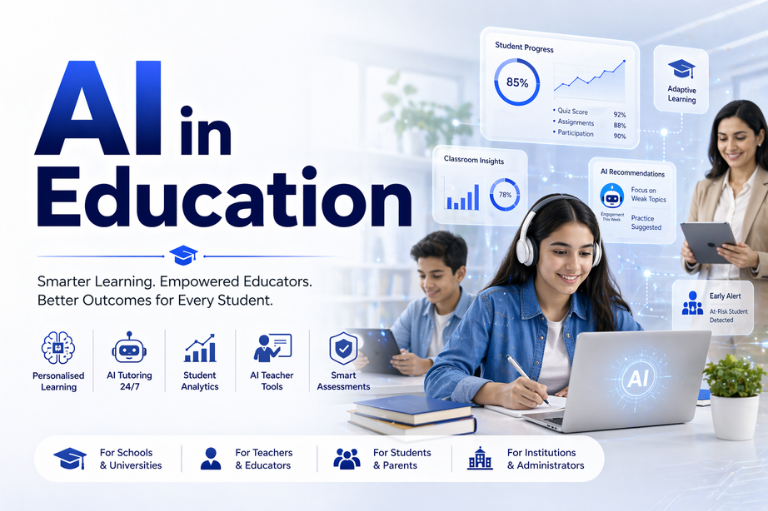
A student sits through a forty-five minute lecture. She understands the first ten minutes. The rest washes over her. There is no way for the teacher to know. This is exactly where AI in education is making a real impact today.
A teacher spends three hours on a Sunday writing lesson plans, grading papers, and sending parent updates. By Monday morning, he is already exhausted.
A school principal needs to know why dropout rates are rising. The data exists somewhere across spreadsheets, attendance records, and test results. Nobody has the time to pull it together.
These are not rare situations. They describe the daily reality of education for hundreds of millions of students, teachers, and administrators around the world.
AI is changing this. And the institutions that move now are already seeing measurable improvements in student outcomes, teacher satisfaction, and operational efficiency.
At Infin Mobile Solutions, we build AI-powered education systems for schools, universities, and corporate training programmes. This article explains the real problems the sector faces and exactly how our solutions address them.
AI in Education in 2026: The Scale of What Is Happening
The global AI in education market reached $9.58 billion in 2026 and is projected to hit $136.79 billion by 2035, growing at a CAGR of 34.52%, according to Precedence Research. The pace of adoption is equally striking.
86% of students globally now use AI tools in their studies. Student AI usage jumped from 66% in 2024 to 92% in 2025, the largest year-on-year rise ever recorded, according to DemandSage’s March 2026 analysis. Teachers who use AI tools weekly save an average of 5.9 hours per week, roughly six extra weeks across a school year.
The challenge is not whether AI belongs in education. It clearly does. The challenge is building systems that work for real teachers, real students, and real institutions. That is where most generic tools fall short. And that is where purpose-built solutions make the difference.
The Problems: What Is Holding Education Back
Every Student Learns at a Different Pace — But They All Get the Same Lesson
One student grasps a concept in five minutes. Another needs twenty, and a different explanation entirely.
In a classroom of thirty, the teacher cannot adapt in real time for every student. The fast learners get bored. The slower ones fall behind. And the gap between them widens with every lesson.
Traditional education is built for the average student. There is no average student.
Teachers Are Overwhelmed by Administrative Work
Teachers who use AI tools save roughly 5.9 hours per week. That means teachers without AI support are spending those hours on admin. According to Resourcera’s 2026 data, 60% of educators now use AI, but 81% say they lack the time to develop proper AI-assisted workflows.
Lesson planning, grading, parent communication, attendance tracking, progress reports. These tasks consume hours that should go toward teaching.
Institutions Cannot Identify Struggling Students Until It Is Too Late
A student’s grades begin to slip in October. By the time the term ends, they have fallen significantly behind.
Nobody intervened because nobody had a clear, early signal that the student needed support. The data was there. It just was not being read.
Dropout rates in higher education can be reduced by 10 to 15% with proper early intervention systems. Most institutions do not have them.
Student Engagement Drops and Nobody Tracks It
Attendance is one metric. Engagement is another. A student can be physically present and completely absent.
Without tools that measure participation, content interaction, and comprehension in real time, institutions cannot distinguish between students who are learning and students who are simply showing up.
Assessment Is High-Stakes but Low-Intelligence
A single end-of-term exam determines a student’s grade. That exam tests memory under pressure. It does not test understanding, application, or progress over time.
Educators know this is a flawed model. But without automated tools for continuous assessment, the workload of ongoing evaluation is simply too high for most teachers to manage alone.
Academic Dishonesty Has Reached a New Level
72% of educators fear AI will increase plagiarism and cheating, according to PassiveSecrets’ 2026 education statistics. Nearly 88% of students acknowledged using generative AI tools for assessments in 2025. Many are doing so without understanding the boundaries.
Institutions need detection tools. They also need to rethink assessment design in an era where AI-generated content is widely available.
Access to Quality Education Is Still Deeply Unequal
A student in a well-resourced school in Dubai has access to AI tutoring tools, premium content, and individualised support. A student in a rural school does not.
AI is widening this gap, not closing it. The institutions and governments that do not actively invest in equitable digital education infrastructure are creating a permanent disadvantage for millions of learners.
Corporate Training Is Generic and Forgettable
An employee sits through a mandatory compliance training module. It is the same module every year. The content is the same regardless of their role, experience level, or learning needs.
Corporate training is one of the most underpowered applications of learning technology. Most organizations know their training does not work. Most do not have the tools to change it.
How Infin Mobile Solutions Helps: Our AI Education Solutions
Personalized Learning Paths for Every Student
We build AI-powered learning systems that adapt to each student in real time.
The system tracks what a student understands, where they are struggling, and how they learn best. It then adjusts the content, pace, and format of lessons accordingly. A student who needs more time on algebra gets it. A student who is ready to move ahead does.
- AI analyses performance data and adjusts learning content dynamically
- Content delivered in multiple formats: video, text, interactive exercises, quizzes
- Personalized revision suggestions based on areas of weakness
- Works across subjects and education levels from K-12 to higher education
A Harvard University study found students using AI tutors learned more than twice as much in less time compared to traditional classroom settings, according to DemandSage. That is the kind of outcome purpose-built personalization delivers.

AI-Powered Teacher Tools That Give Time Back
We build systems that handle the administrative burden so teachers can focus on teaching.
Lesson plans are generated from curriculum guidelines. Assignments are graded automatically with detailed feedback. Parent progress reports are compiled and sent without manual input. Attendance is recorded and anomalies are flagged.
- AI lesson plan generation based on curriculum standards and student performance data
- Automated grading for objective assessments with detailed feedback
- AI-assisted feedback generation for written assignments
- Automated parent communication and progress report generation
- Attendance tracking with AI-flagged absence patterns
Teachers who use AI save nearly six hours a week. That time goes back to students. That is what these tools are built for.

Early Intervention Alerts to Stop Students Falling Behind
Our system monitors student performance, attendance, and engagement continuously. When a student’s pattern begins to indicate risk, an alert goes to their teacher or advisor immediately.
This happens weeks before a grade drops significantly. The intervention can be a check-in conversation, additional support resources, or a referral to counselling. The key is that it happens early.
- Real-time student performance monitoring across all subjects
- AI risk flagging based on attendance, grades, and engagement patterns combined
- Automated alerts to teachers, advisors, and parents
- Suggested intervention actions based on the type of risk detected
- Dropout prediction modelling for higher education institutions
Student Engagement Tracking Beyond Attendance
We build tools that measure actual engagement, not just physical presence.
How long did a student spend on each section of content? How many times did they replay a video? Did they complete practice exercises? Did their interaction time drop this week compared to last?
These signals give teachers and administrators a real picture of who is engaged and who is drifting before any formal assessment reveals it.
- Content interaction tracking across every learning resource
- Time-on-task monitoring for digital coursework
- Participation scoring for class discussions and group activities
- Weekly engagement dashboards for teachers and department heads
- Comparative engagement data across cohorts and subjects
Continuous Assessment Tools That Replace the End-of-Term Exam Bottleneck
We build continuous assessment systems that distribute evaluation throughout the learning journey.
Short quizzes after each lesson. Competency checks before moving to the next unit. AI-generated assignments that test the same concept in different ways to ensure genuine understanding, not memorisation.
- AI quiz generation aligned to curriculum objectives
- Adaptive question difficulty based on individual student performance
- Instant results and feedback at the point of assessment
- Competency-based progression: students advance when they are ready
- Assessment data feeds directly into student performance dashboards
AI-Assisted Academic Integrity Monitoring
We build academic integrity tools that help institutions manage AI use responsibly.
AI content detection flags submissions that are likely AI-generated. Plagiarism checks run automatically on every submission. Assessment design tools help educators create questions that require genuine thinking rather than content reproduction.
- AI-generated content detection on written submissions
- Plagiarism checking integrated into the submission workflow
- Assessment design assistance to create AI-resistant question types
- Student AI literacy modules built into the learning platform
- Institutional usage analytics showing AI use patterns across cohorts
Accessible Digital Learning for Underserved Students
We build lightweight, low-bandwidth compatible learning systems designed for markets where infrastructure is variable.
Offline access to core content. SMS-based assessment delivery where smartphones are unavailable. Multilingual interfaces for local language instruction.
Quality education technology should not require a premium internet connection. We build for the real world, not the ideal one.
- Offline content access with automatic sync when connectivity returns
- Multilingual support for local language instruction
- Low-data mode for students in connectivity-constrained environments
- SMS and USSD-based assessment for feature phone users
- Device-agnostic: works on low-end Android devices
AI-Powered Corporate Training That Actually Works
We build corporate learning platforms that deliver training based on each employee’s role, experience level, and existing knowledge.
An onboarding module for a new sales hire is different from a compliance refresher for a senior engineer. AI builds the right learning path for each person, tracks their progress, and surfaces skill gaps that managers can act on.
- Role-based personalised learning paths for every employee
- AI skill gap analysis based on role requirements and current competencies
- Microlearning modules for high-retention, low-time training delivery
- Progress dashboards for managers and L&D teams
- Certification tracking and automated renewal reminders
- Integration with existing HR systems for seamless employee data sync

Where AI Makes the Biggest Difference in Education
AI does not replace teachers. It makes them more effective.
A teacher with AI tools can give thirty students a more personalised experience than a teacher without AI could give to five. That is not hypothetical. A 2025 Harvard study confirmed that students using AI tutors learned more than twice as much in less time compared to traditional instruction.
AI also shifts the teacher’s role. Less time on grading, attendance, and reporting means more time on the parts of teaching that actually require a human: building relationships, facilitating discussion, and helping students navigate challenges that go beyond curriculum.
For institutions, AI means the data they already collect becomes actionable. Student performance data has always existed. AI turns it into early warnings, strategic insights, and resource allocation decisions that improve outcomes at scale.
Education Has Always Been About People. AI Makes It More Human.
The goal of AI in education is not to replace the teacher-student relationship. It is to remove the obstacles that prevent that relationship from being as effective as it could be.
When teachers are freed from administrative work, they teach better. When students receive content pitched at their actual level, they learn more. When institutions can see problems emerging early, they intervene before students are lost.
Infin Mobile Solutions builds the systems that make this happen. For schools, universities, and corporate training programmes across India, the UAE, Saudi Arabia, Southeast Asia, and beyond.
If you want to know what an AI-powered education system would look like for your institution, we would like to help you figure that out.
Contact Infin Mobile Solutions at infinmobile.com/contact-us and we will take it from there.
Frequently Asked Questions
What problems does AI solve in education?
AI in education addresses several major challenges: lack of personalised learning for individual students, administrative overload for teachers, inability to identify at-risk students early, poor engagement tracking, high-stakes assessment models that miss ongoing progress, academic integrity challenges in an AI-saturated environment, and unequal access to quality education resources.
How does AI personalise learning for students?
AI analyses each student’s performance, learning pace, and areas of difficulty in real time. It adjusts the content, format, and difficulty of learning materials to match where each student currently is. Students who need more time on a concept get it. Students who are ready to progress do so without waiting for the rest of the class.
How much time does AI save for teachers?
Teachers who use AI tools at least once a week save an average of 5.9 hours per week, equivalent to roughly six extra weeks across a school year. These savings come primarily from automated lesson planning, grading, attendance tracking, and parent communication.
Can AI detect when a student is at risk of dropping out?
Yes. AI systems can monitor combinations of attendance, performance, and engagement data to identify students whose patterns indicate risk of disengagement or dropout weeks before it becomes visible in formal assessments. This enables early intervention that has been shown to reduce dropout rates by 10 to 15%.
How does Infin Mobile Solutions make education technology work in low-connectivity environments?
We build lightweight, low-bandwidth compatible systems with offline content access, low-data modes, multilingual interfaces, and SMS-based assessment options for feature phone users. Our systems are designed for real-world infrastructure conditions in markets like India, South Africa, Nigeria, and Southeast Asia, not for ideal connectivity environments.
How do I find out what an AI education system would cost for my institution?
Every institution has different requirements — scale, existing systems, subjects covered, and student populations all affect scope. Contact Infin Mobile Solutions at infinmobile.com/contact-us with your requirements and we will provide a clear, honest assessment within 48 hours.