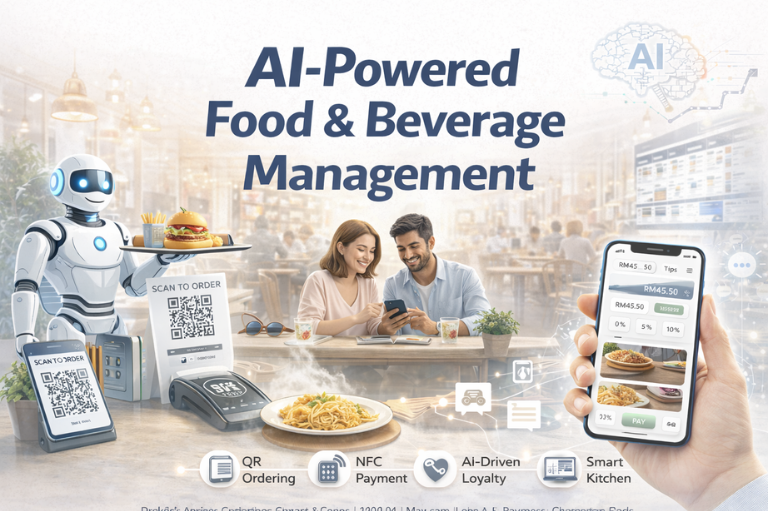
AI in restaurants is transforming how modern food businesses operate, from digital ordering and contactless payments to AI-powered analytics and automation. In today’s competitive food and beverage industry, adopting smart technology is essential for improving efficiency, customer experience, and overall business growth.
A table of four sits down at a restaurant. They wait seven minutes before anyone takes their order. The waiter writes it on a notepad, hands it to the kitchen, and a dish gets missed.
At the end of the meal, the bill takes another ten minutes. One guest wants to pay separately. The card machine is at the counter. Everyone waits.
This is the standard restaurant experience in 2026. Not because the staff are careless. Because the systems are outdated.
Restaurants that modernize their operations with smart technology are seeing faster service, fewer errors, higher table turnover, and customers who come back more often.
At Infin Mobile Solutions, we build the systems that make this happen. This article explains the real problems restaurants face and how our solutions fix them, including our live deployment for Komugi Bakery in Malaysia.
The F&B Sector & AI in Restaurants in 2026: Why Technology Is Now a Competitive Necessity
The global restaurant technology market is projected to reach $45.3 billion by 2027, growing at 9.8% annually, according to Grand View Research. QR code ordering adoption surged by over 300% post-pandemic and has held firm as a customer expectation, not just a convenience feature.
Contactless payments now account for more than 50% of in-store transactions in markets like the UAE and Malaysia, according to Mastercard’s 2026 payments report. Customers expect to tap and go. Restaurants that still rely on cash handling and manual billing are falling behind.
The restaurants winning in 2026 are not the ones with the best chefs alone. They are the ones that pair great food with seamless technology.
The Real Problems Restaurants Face and How We Solve Them with AI in Restaurants
1: Taking Orders Is Slow and Prone to Human Error
Problem: A waiter takes an order verbally, tries to remember it, and writes it down later. A dish gets missed. A modification is forgotten. The wrong item reaches the table.
In a busy restaurant during peak hours, this happens dozens of times a shift. Staff are stretched. Errors go to the kitchen. By the time the mistake is caught, the table is frustrated. AI in restaurants helps automate daily operations and reduce manual effort.
Solution: Our QR code ordering system removes this problem entirely. Customers scan a QR code at the table, browse the digital menu, and place their order directly. The order goes straight to the kitchen display system with no manual step in between.
No waiter needed for order-taking. No miscommunication. No missed items.
- Each table has a unique QR code linked to its number in the system
- Customers browse the full menu with photos, descriptions, and allergen information
- Orders appear on the kitchen display the moment they are placed
- Modifications and special requests are captured in text, not verbal instruction
- Multiple courses can be ordered at different times from the same session
- Staff are freed to focus on service, not administration
2: Billing Is Slow and Splitting Payments Is a Nightmare
Problem: The meal is finished. The table asks for the bill. The waiter goes to the POS, prints the receipt, brings it back, collects the card, goes to the machine, returns. Five minutes minimum.
If the table wants to split the bill, multiply that by four.
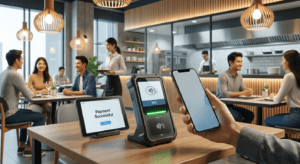
Solution: Our NFC tap-to-pay system solves this at the table. Customers pay directly from their seat using their phone or card. No waiting for the machine. No hunting for the waiter.
For restaurants with high table turnover, this alone shortens the average meal time and gets more covers through the door each service. With AI in restaurants, businesses can improve order accuracy and speed.
- Customers tap to pay directly at the table using NFC-enabled phone or card
- Bill splitting handled digitally — each guest pays their portion through the system
- Payment confirmation is instant — receipt sent to email or phone
- Tips can be added digitally at the point of payment
- All transactions recorded automatically in the restaurant’s reporting system
- Supports multiple payment methods — card, digital wallet, and QR payment
3: Customers Come Once and Never Return
Problem: A customer has a great meal. There is no reason for them to think of this restaurant next time they are deciding where to eat.
Most restaurants have no system to stay connected with their customers after they leave. No loyalty programme. No personalised offers. No reason to come back.
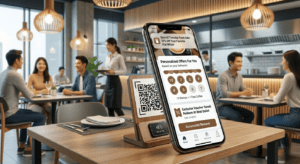
This is where AI plays a significant role in the F&B sector. Our AI-powered loyalty and rewards system tracks customer behaviour, identifies high-frequency visitors, and delivers personalised offers that bring people back. AI in restaurants enhances customer experience through personalization.
Solution: A customer who orders coffee every Tuesday morning gets a stamp reward after five visits. A customer who has not visited in three weeks gets a discount notification. The system does this automatically, based on real behaviour, not guesswork.
- Digital stamp cards replace physical cards that get lost or forgotten
- AI identifies purchase patterns and sends personalised offers at the right moment
- Push notifications for flash sales, seasonal promotions, and new items
- Wallet system lets customers accumulate rewards and redeem them in the app
- Social sharing rewards: customers earn bonus points for sharing on social media
- Restaurant gains data on its most loyal customers and what they order most
4: The Kitchen Has No Real-Time Visibility on Incoming Orders
Problem: During peak hours, orders pile up. The kitchen team does not have a clear view of what is coming, what is pending, and what was placed fifteen minutes ago and still has not been started.
Chefs shout across the pass. Tickets get lost. Dishes go out at different times for the same table.
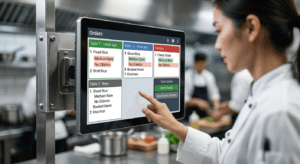
Solution: Our kitchen display system gives the kitchen team a live, prioritised view of every active order. When a customer places an order via QR code, it appears on the screen immediately with the table number, items, and any modifications. Many brands are adopting AI in restaurants to stay competitive.
- Real-time order display as soon as customers confirm from the table
- Orders sorted by time received — oldest orders flagged automatically
- Item-level status tracking: chefs mark each dish when it is ready
- Table-level view: kitchen sees all items for a table to coordinate timing
- Alerts when an order has been waiting beyond the expected preparation time
- Reduces verbal communication in the kitchen and the errors that come with it
5: Menu Updates Are Slow and Paper Menus Waste Money
Problem: A dish sells out. The waiter has to tell every table that asks. A price changes. Thousands of menus are already printed.
Seasonal items, daily specials, and sold-out updates all require manual communication in a restaurant running paper menus.
Solution: With a digital menu system, updates happen instantly. A dish is sold out? The manager marks it in the system and it disappears from every customer’s screen immediately. AI in restaurants also improves data-driven decision making.
- Menu changes go live instantly across all tables, no reprinting, no delays
- Photos and descriptions make the menu more engaging than a printed list
- Sold-out items removed in seconds without staff needing to explain
- Pricing updates applied once and reflected everywhere
- Seasonal menus and promotional items switched on and off by schedule
- Multilingual menus available for restaurants serving international customers
6: Managers Have No Visibility into What Is Actually Selling
Problem: End of the day. The manager wants to know which dishes performed well, which table had the highest spend, and what time the lunch rush peaked.
With a manual system, this information does not exist. Or it takes hours to compile from paper receipts and a spreadsheet.
Solution: AI-powered restaurant analytics changes this completely. Every order, every payment, and every table session is captured and turned into insight automatically. AI in restaurants enables smarter kitchen management systems.
- Real-time sales dashboard by item, category, and time period
- AI identifies top-performing dishes and those that are underordered
- Peak hour analysis helps with staffing decisions
- Average spends per table and per cover tracked automatically
- AI demand forecasting helps predict busy periods and reduce food waste
- Reports generated automatically, no manual data entry required

7: Managing Inventory and Food Waste Is Guesswork
Problem: A restaurant over-orders ingredients on a slow week. Half of it goes to waste. The following week, a key ingredient runs out mid-service.
Most restaurants manage inventory based on experience and intuition. AI replaces intuition with data.
Solution: Our system tracks ingredient usage against sales data. It identifies which dishes drive which ingredient consumption. It flags when stock is running low and can suggest reorder quantities based on predicted demand for the days ahead. AI in restaurants supports faster and more secure payments.
- Ingredient-level inventory tracking linked to menu item sales
- Low stock alerts before items run out mid-service
- AI demand forecasting based on day of week, season, and historical patterns
- Waste tracking: identifies where ingredients are being discarded most frequently
- Automatic reorder suggestions based on predicted usage

Live Deployment: Komugi Bakery Loyalty Rewards System, Malaysia
The best way to understand what Infin Mobile Solutions builds is to look at what we have already delivered.
Komugi Bakery is a well-established bakery chain with 12 outlets across Malaysia. They came to us with a clear goal: build a digital loyalty system that keeps customers coming back, increases repeat visits, and gives the business real insight into its most loyal patrons.
Client: Komugi Bakery | Market: Malaysia (12 outlets) | Tech: Kotlin (Android), Swift (iOS), Laravel, MySQL, Azure, MOLPay | infinmobile.com/client/komugi-loyalty-reward-app/
The Problem
Komugi had loyal customers. But there was no system to recognise them, reward them, or communicate with them after they left the outlet.
Physical stamp cards were easy to lose and hard to track. There was no way to know which customers visited most often, what they ordered, or when they were due for a reward.
Marketing was broadcast the same message to everyone, with no personalization.
What We Built
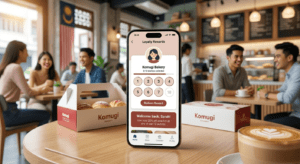
We designed and developed a full loyalty rewards platform for Komugi, covering iOS, Android, and a backend management system.
Customers earn digital stamps with every purchase. No physical card to carry or lose. Stamps accumulate in the app wallet and can be redeemed for cash value once a threshold is reached.
The news and promotions feature keeps customers updated on new products, flash sales, seasonal offers, and outlet-specific deals directly on their home screen. No email open rates to worry about. Direct, push notification-based communication.
A social sharing feature rewards customers for spreading the word. When a customer shares a promotion on social media, they earn additional points in their wallet. This turns satisfied customers into a marketing channel. AI in restaurants reduces operational costs significantly.
The voucher system lets customers save and manage exclusive offers. Vouchers are redeemed at the nearest outlet, with the system verifying and recording the redemption automatically.
An outlet finder shows customers the nearest Komugi bakery, with operating hours, contact details, and current promotions specific to that location.
Technology Stack
- Android: Kotlin
- iOS: Swift with Objective-C
- Backend: Laravel with PHP
- Database: MySQL
- Cloud: Microsoft Azure
- Payments: MOLPay (Malaysia’s leading digital payment gateway)
The Outcome
Komugi now has a direct digital relationship with its customers across all 12 outlets in Malaysia.
Customers engage with the brand between visits, not just when they are at the counter. The business has real data on its most loyal patrons and what drives their visits. AI in restaurants is becoming essential for modern F&B businesses.
It is a clear example of what technology can do for an F&B brand that is not just about processing orders, but about building lasting customer relationships. AI in restaurants allows better inventory and demand forecasting.
Full case study: infinmobile.com/client/komugi-loyalty-reward-app/
Where AI Makes the Biggest Difference in F&B
The systems described above create the infrastructure. AI adds the intelligence on top.
Here is where AI has a direct, measurable impact in a restaurant operation. AI in restaurants helps automate daily operations and reduce manual effort.
How AI in Restaurants Improves Customer Experience
AI analyses purchase history and visit frequency to identify customers who are at risk of not returning. It triggers personalised offers automatically, based on real behaviour.
A customer who visited every week for a month and then stopped gets a targeted offer within seven days of their last visit. This happens without any manual input from the restaurant team.
AI Demand Forecasting
AI looks at historical sales data, day of week patterns, local events, and weather trends to predict how busy a restaurant will be and what will sell most on a given day.
This helps managers plan staffing, prepare the right amount of each ingredient, and reduce the food waste that comes from over-preparation on slow days.
AI Menu Optimisation
Not every item on the menu contributes equally to revenue. AI identifies which dishes drive the highest margin, which are frequently ordered together, and which consistently underperform.
This gives restaurant owners data to make smarter decisions about what to promote, what to remove, and how to structure the menu for maximum revenue.
AI Personalisation for Loyalty Programmes
A generic loyalty programme gives everyone the same reward for the same action. An AI-powered system understands that one customer visits for coffee in the morning while another comes for weekend brunches.
Each gets rewards and promotions relevant to their actual behaviour. Engagement is higher. Redemption rates improve. Customers feel recognised, not marketed to.
The Restaurant Business Has Always Been About People. Technology Makes It Better.
QR code ordering is not about removing the human element from dining. It is about freeing staff from the administrative parts of their job so they can focus on hospitality.
NFC payments are not just a convenience. They reduce friction at the end of a meal and get tables turned faster.
AI loyalty systems are not just a marketing tool. They build genuine customer relationships at a scale that no team could manage manually.
Infin Mobile Solutions builds these systems for restaurants, cafes, bakery chains, and F&B operators across Malaysia, the UAE, India, Southeast Asia, and beyond.
If you want to know how this technology could work for your operation, or if you are ready to start building, we would like to hear from you.
You can reach the Infin Mobile Solutions team at infinmobile.com/contact-us. Tell us about your operation and we will take it from there.
Frequently Asked Questions
What is QR code ordering and how does it work in a restaurant?
QR code ordering is a system where each table has a unique QR code. Customers scan it with their phone, browse the digital menu, and place their order directly. The order goes to the kitchen system immediately with no manual step. Staff receive no verbal instruction and make no handwritten notes. The order arrives exactly as the customer entered it.
How does NFC tap-to-pay work at a restaurant table?
NFC (Near Field Communication) allows customers to pay by tapping their phone or card against a reader. In a restaurant setting, the payment can be triggered directly from the customer’s device at the table once the meal is complete. No card machine is brought to the table. No waiting for the waiter. The transaction is confirmed instantly and a digital receipt is sent automatically.
How does AI in Restaurants improve a restaurant loyalty programme?
AI analyses each customer’s visit frequency, order history, and engagement patterns. It uses this data to send personalised offers at moments when they are most likely to be relevant. A customer who has not visited in three weeks receives a targeted offer. A high-frequency visitor gets early access to new items. The system operates automatically, without requiring any manual segmentation or campaign management.
What is a kitchen display system and why does it matter?
A kitchen display system is a screen in the kitchen that shows incoming orders in real time. When a customer places an order via QR code, it appears on the kitchen display immediately with the table number, items, and any modifications. Chefs can see all active orders, their timing, and their status. This replaces verbal communication and printed tickets, reducing errors and improving coordination across a busy service.
What did Infin Mobile Solutions build for Komugi Bakery in Malaysia?
Infin Mobile Solutions built a full digital loyalty rewards platform for Komugi Bakery, a chain with 12 outlets across Malaysia. The system includes digital stamp collection, a wallet for accumulating rewards, a voucher management feature, push notification-based promotions, social sharing rewards, and an outlet finder. It was built on Kotlin for Android, Swift for iOS, Laravel for the backend, MySQL for the database, hosted on Azure, and integrated with MOLPay for payments.
Which markets does Infin Mobile Solutions serve for F&B technology?
Infin Mobile Solutions builds restaurant and F&B technology for clients across Malaysia, the UAE, India, Saudi Arabia, Singapore, and Southeast Asia. Each system is built for the specific market conditions, payment infrastructure, and customer expectations of the region it serves.
How do I find out what it would cost to build this for my restaurant?
Every restaurant operation is different. The right approach depends on your size, your locations, your current systems, and what problems you most need to solve. Contact Infin Mobile Solutions at infinmobile.com/contact-us with your requirements and we will provide a clear, honest assessment of what makes sense for your business.